What is a dental implant restoration? Types and components explained
Short answer
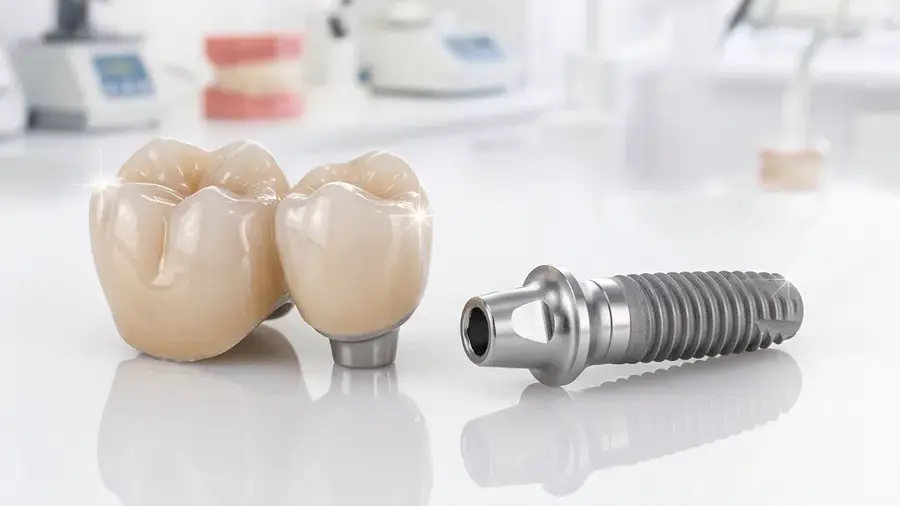
A dental implant restoration is the visible tooth or teeth attached to a dental implant. It has three parts: the implant in the jawbone, the abutment that connects to it, and the crown, bridge or denture on top. The main types are single implant crowns, implant bridges, implant-retained overdentures and fixed full-arch bridges, attached either with a screw or with cement.
The parts of an implant restoration
- Implant: the titanium or zirconia post placed in the jawbone. It acts as the tooth root.
- Abutment: the connector that attaches to the implant and supports the crown. It can be a stock part, a titanium base (ti-base) or a custom abutment designed for the case.
- Restoration: the crown, bridge or denture that you see, usually made in zirconia, porcelain or acrylic.
- Screw: a small screw holds the abutment, or the whole restoration, onto the implant.
What is an implant abutment?
The abutment sits between the implant and the crown. A custom abutment is designed for each patient in CAD software so that it supports the gum and places the edge of the crown exactly where the dentist wants it. Custom abutments are made in titanium for strength or zirconia for appearance at the front of the mouth. See our custom abutments.
Types of implant restoration
- Single implant crown: one implant replaces one tooth.
- Implant bridge: two or more implants support a bridge that replaces several teeth.
- Implant-retained overdenture: a removable denture clips onto implants or an implant bar.
- Fixed full-arch bridge: a whole arch of teeth is screwed onto four or six implants, such as All-on-4 or All-on-6.
Screw-retained or cement-retained?
A screw-retained restoration is held by a screw through the crown, so the dentist can remove it later and there is no excess cement under the gum. A cement-retained restoration is cemented onto an abutment, which can suit some implant angles and aesthetic cases. The dentist chooses based on the implant position and the case.
How a dental lab makes an implant restoration
- The dentist sends a scan with scan bodies, or an implant-level impression, plus the implant system and platform.
- The technician designs the abutment and crown in CAD software.
- The parts are milled, or made with matching implant components.
- The restoration is finished, checked on the model and returned to the dentist to fit.
Dentists can read more about our implant restorations, and patients can read about what affects implant cost.
Frequently asked questions
What is the difference between an implant and an abutment?
The implant is the post placed in the jawbone. The abutment is the connector that attaches to the implant and holds the crown.
What is a dental implant restoration made of?
The implant is usually titanium, the abutment titanium or zirconia, and the crown zirconia or porcelain. Full-arch restorations may also use acrylic or composite teeth.
Can an implant crown be replaced?
Yes. A crown on an implant can be replaced if it wears or breaks, especially if it is screw-retained.